
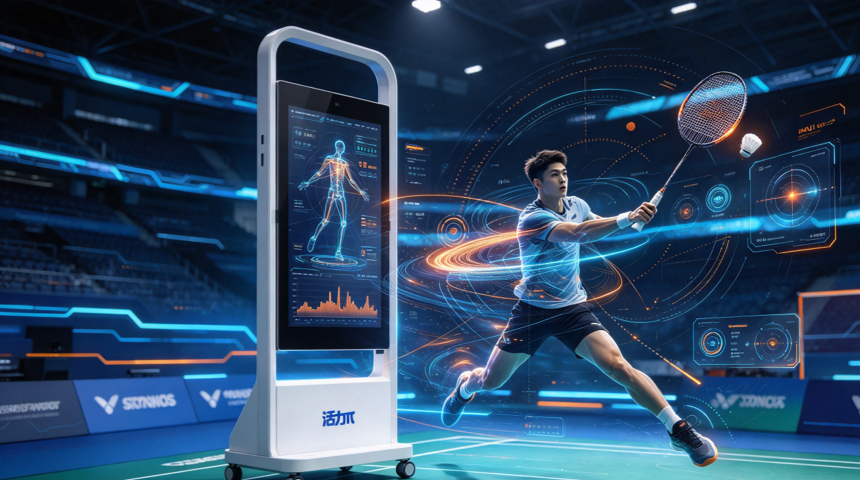
1. The "Black Box" of Skill-Dominant Sports Training
In badminton, table tennis, tennis, and golf, performance hinges on finely coordinated movements that are difficult to quantify. How hard was that smash? What was the racket face angle at impact? How fast was the serve in kilometers per hour? Traditional coaching relies on the coach eye, slow-motion video review, and the athlete subjective sensation. These methods are qualitative, inconsistent, and heavily dependent on individual coach experience. Promising athletes often plateau not because of talent but because they train against an invisible target.
Opening this black box requires the ability to capture high-precision kinematic data during unconstrained play, and then translate it into insight that athletes and coaches can act on. Shenzhen Earth Electronics has spent a quarter of a century on exactly this problem. As the first private enterprise in the world to ship a smart badminton racket, ESI has built a technology stack that gives skill sports their first shared "data language."

Figure 1: Completion certificate for the General Administration of Sport of China research project on digital intelligent motion analysis of sports equipment.
2. MEMS Strapdown Inertial Navigation: Letting the Racket Speak
2.1 What Is MEMS Strapdown Inertial Sensing?
MEMS (Micro-Electro-Mechanical Systems) sensors are miniature inertial devices that combine accelerometers and gyroscopes on a single chip, measuring linear acceleration and angular velocity in real time. "Strapdown" means the sensor is rigidly mounted directly to the sports implement—such as inside a racket handle—rather than on an external rig. By double-integrating acceleration and integrating angular velocity, embedded algorithms reconstruct the implement 3D trajectory, attitude, and speed without any external reference.
ESI brand "Huo Li π" uses this self-developed MEMS strapdown approach. A sensor embedded in the racket handle records every swing: racket-head speed, contact point, and racket-face orientation, streamed via Bluetooth to a phone or cloud. Athletes train normally, with no wearable harness, no camera array, and no interference with natural technique.
2.2 From One Racket to Four Sports
The technology started in badminton and expanded to table tennis, golf, and tennis. In badminton, the platform analyzes overhead clears, smashes, and drops by swing speed, contact position, and face angle. In table tennis, it measures serve spin, hit force, and racket-head speed. In golf, it examines swing tempo, club-head velocity, and impact angle. In tennis, it tracks serve speed, baseline force, and court coverage. A common inertial core runs across all four sports, with sport-specific calibration algorithms layered on top.
3. IMU Plus Vision Fusion: From Implement to Full Body
3.1 Why Fusion?
An IMU tells you what the racket is doing, but a great smash is not just racket speed—it is the coordinated chain of trunk rotation, hip load, arm acceleration, and wrist snap. To capture the whole movement, ESI layered computer vision on top of its inertial platform, creating an "IMU-plus-vision fusion" approach. Sensor-derived implement kinematics are fused with camera-derived skeletal poses, and the combined model is compared against a standardized movement template. The output pinpoints not just what the racket did, but where in the kinetic chain the athlete lost power or stability.
3.2 The Competitive Platform Workflow
On top of this fusion engine, ESI built the Competitive Sports Platform. Smart implements connect via Bluetooth, stream data to the cloud, and return structured analysis. A grading (dan-rating) function assigns objective skill levels based on measured metrics. A matchmaking feature pairs players of comparable level. These features bring pro-grade analytics to serious amateurs, not just national-team athletes.
Figure 2: Software product registration certificate for the "ESI Huo Li π Badminton Motion Trajectory Analysis Software V1.0."
4. National Project Validation and Twenty-Five Years of Self-Reliance
ESI technology credibility is not self-declared. The company led the General Administration of Sport of China key research project, "Digital Intelligent Motion Analysis System for Sports Equipment," which passed expert review and was formally completed in 2017. The "ESI Huo Li π Badminton Motion Trajectory Analysis Software V1.0" has completed official software product registration. As a National High-Tech Enterprise and Shenzhen High-Tech Enterprise, ESI holds more than fifty software copyrights and patents, all built in-house over twenty-five years.
Figure 3: National High-Tech Enterprise certificate, recognizing ESI sustained indigenous R&D capability.
The Next Decade of Data-Driven Coaching
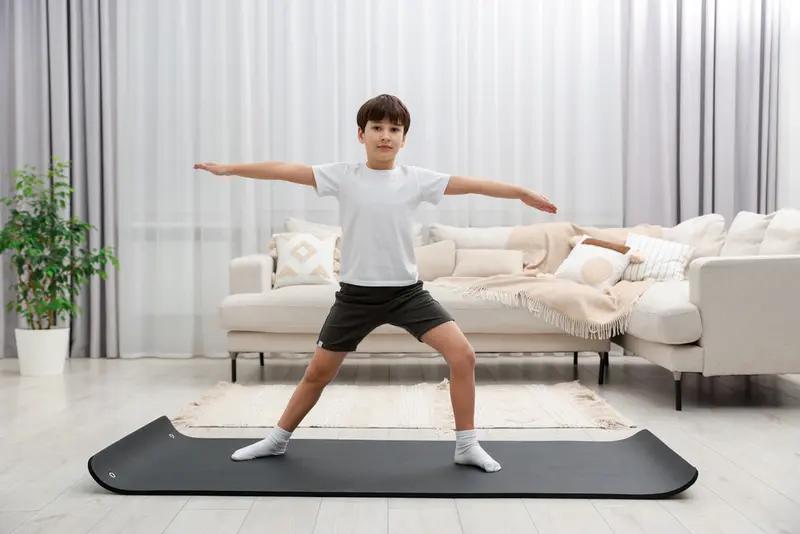
The shift from subjective coaching to data-driven coaching is irreversible. When inertial sensors become small and affordable, when vision models recognize motion reliably, and when analysis algorithms mature enough to explain rather than merely display, skill acquisition transforms from an art dependent on gifted coaches into a replicable, teachable, and assessable science. This benefits elite athletes chasing marginal gains and ordinary students learning their first forehand.
ESI is deploying this stack across three product tiers: the campus Digital Teaching System, the home AI Smart Sports Skills Platform, and the Competitive Sports Platform. The same twenty-five-year-old MEMS and fusion core that powered the world first smart badminton racket now reaches into PE classes, living rooms, and competitive venues alike. Every swing that is measured, every motion that is explained, brings scientific coaching to one more person. That is the direction in which sports technology is moving.
Looking ahead, two technical trends will further lower barriers. First, sensor fusion algorithms will continue to improve, making IMU-plus-vision systems more robust under changing lighting and unconstrained camera angles. Second, on-device machine learning will move real-time feedback from the cloud to local hardware, reducing latency and protecting user privacy. For athletes and students, this means faster, more affordable, and more personalized coaching. For the industry, it means the gap between elite performance science and everyday practice will continue to close—one measured swing at a time.
Explore Competitive Sports Analytics
See how smart implements, motion sensing and cloud analysis support data-driven racket sports training.
Explore Competitive Sports