
Table of Contents
1. The Problem With Subjective PE Grades
In most schools, a PE grade is still a teacher's impression. The same rope-skip performance can earn an A from one teacher and a B from another; effort, behaviour and even likeability quietly leak into a number that is supposed to measure movement skill. This subjectivity has real consequences. Students cannot see why they scored what they scored, parents cannot compare progress, and teachers cannot defend a grade with evidence.
The fix is not to remove teachers but to give them a shared, transparent standard. That is what AI PE grading does: it turns “how did it look?” into “how close was it to the standard, and by how much?”
2. What “AI Scoring” Really Means
AI scoring is not a black box that watches students and prints grades. It is a pipeline: capture the movement, measure it quantitatively, compare it with a defined standard, and produce a score plus an explanation. Because the standard is the same for every student, the grade is consistent across classes, teachers and schools. Because the explanation is generated automatically, a student learns what to fix, not just what they got.
The pipeline also makes grading explainable. When a score can be traced back to a rubric, a measurement and a comparison, it can be defended in a parent meeting, an audit or a school leadership review. Explainability is what separates AI assessment from a mysterious algorithm — and it is the reason digital PE systems publish their rubrics rather than hiding them.
3. From Standards to Rubrics: How Movements Become Scores
Every exercise a school wants to grade needs a rubric: what counts, what is measured and how points are awarded. Digital PE systems ship with rubrics for common school activities and let teachers adjust the weights. Examples include:
| Exercise | What Is Measured | How It Is Scored |
|---|---|---|
| Rope skipping | Rhythm, completion count | Completion count plus consistency score |
| Squats | Depth, knee angle, tempo | Angle compared with standard, rep quality |
| Shuttle run | Time plus turn technique | Raw time with form adjustment |
| Calisthenics | Posture and coordination | Frame-by-frame match with demonstration |
The same movement data can also feed PE entrance exam training, where students practise the exact test movements and watch their scores improve week by week. Our AI PE entrance exam training guide explains the complete home-and-school workflow.
4. How IMU + Vision Fusion Produces a Score
Behind the rubric sits motion technology that measures what the eye cannot see reliably.
4.1 Capture
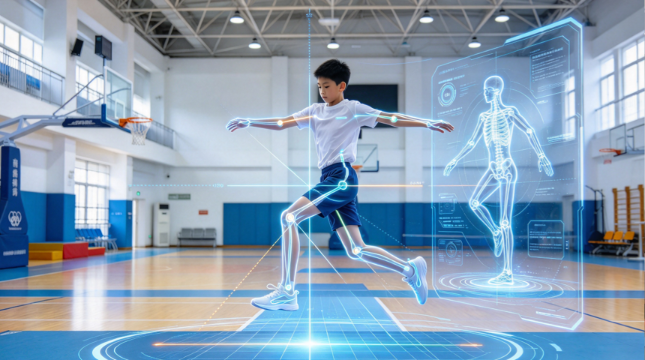
Cameras read body posture while inertial units on equipment or wearables capture speed, angle and force. Together they record the movement from two complementary angles — what the body is doing and what the equipment is doing.
4.2 Quantify
The system converts each frame into numbers: joint angles, rhythm, force curves. Nothing is left to impression, and the same input always produces the same measurement.
4.3 Compare
The numbers are compared frame by frame with a standard demonstration. The difference becomes the basis of the score — for example, the exact point where a knee bends too early in a squat.
4.4 Grade and Explain
The score is generated from the rubric, and the explanation shows the student where points were lost. For a deeper look at the hardware, read our guide to MEMS inertial sensors and sports motion tracking and the sports motion analysis guide.
Because the whole pipeline runs in real time, feedback is immediate. A student who finishes a rope-skip set sees the score and the points lost within seconds, while the teacher's dashboard updates across the whole class at the same moment. Immediate feedback is one of the strongest predictors of learning — and it is something a paper grade book can never deliver.
5. Accuracy and Fairness: The Tough Questions
Fairness is the first question teachers ask, and it deserves a direct answer. AI grading is consistent: the same movement earns the same score every time, from any teacher, in any school. It is transparent: the rubric is visible and adjustable, so parents can see exactly what a grade means. And it removes the biases that creep into human scoring — effort, behaviour and popularity no longer leak into a movement grade.
Accuracy has limits worth naming. The system scores what it can measure: movement, timing, rhythm and completion. It does not judge teamwork, creativity or effort — those remain the teacher's professional call. The best deployments use AI for the measurable part and teachers for the human part, which is why digital PE systems are built around a teacher portal where the instructor always has the final say.
A concrete example makes the difference tangible. Grade the same recorded squat video twenty times by hand, and the scores will drift with fatigue, mood and memory. Run the same video through a digital rubric twenty times, and the result is identical every time. That reliability is the foundation of fairness: when students, parents and administrators know the standard is fixed, conversations about grades shift from “why did I get this?” to “what do I need to improve?”
6. What This Means for Teachers and Students
For teachers, the payoff is scale. One instructor can supervise forty students, watch the dashboard flag students who are struggling, and intervene where it matters — instead of spending the lesson counting reps. For students, assessment becomes coaching: a score comes with a comparison and a next step, so PE stops being a mystery grade.
This is the same architecture described in our article on digital PE assessment, teacher portals and student dashboards, and it is why K-12 leaders are treating AI scoring as a core feature of the modern PE department — see our overview of AI transforming K-12 physical education.
7. Getting Started: What Schools Need
A school does not need to rebuild its gym. Typical deployments add interactive terminals and optional wearables to existing facilities and run on a standard network. The vendor should tailor the exercise library to your curriculum, which is why procurement guides emphasise customisation — see our guide to customizable AI physical education equipment.
When evaluating vendors, check that the exercise library matches the activities you actually teach, that rubrics can be adjusted, that class reports can be exported, and that the system has real deployment references. Systems built on this model have been selected for provincial recommended equipment lists — details in our roundup of the 2024 and 2025 Liaoning equipment catalogues. Start from the campus digital PE solution page to review the architecture, and browse the insights library for more implementation guidance.
Rollout is typically gradual. Many schools pilot digital assessment in one grade or one set of activities first, compare the AI scores with teacher judgment for a term, adjust the rubrics, and then expand. Because the hardware is portable and the software is cloud-based, a pilot needs little more than a gym, a network and a training session for the PE team.
8. Frequently Asked Questions
How does AI actually grade a movement?
The system captures the movement with cameras and inertial sensors, quantifies it into speed, angle and force data, compares it frame by frame with a standard demonstration, and applies a visible rubric to produce a score with an explanation of where points were lost.
Is AI grading fairer than a human teacher?
It is more consistent and transparent. The same movement earns the same score every time, the rubric is visible to parents and administrators, and biases such as behaviour or popularity do not affect the movement grade.
What happens when the AI marks something wrong?
The teacher portal gives instructors the final say. A teacher can review flagged results, adjust rubrics and override scores — the system is a measurement tool, not an unaccountable judge.
Does AI replace the PE teacher's judgment?
No. AI scores the measurable part of movement; teachers still assess teamwork, effort and creativity, and they decide how the numbers are used.
Which exercises can AI score?
Common school activities such as rope skipping, calisthenics, squats, dumbbell routines and shuttle runs are covered by standard rubrics, and the library can be tailored to a school's curriculum.
Can AI scores be used in official PE exams?
The system is widely used for in-school assessment and entrance-exam training practice. Whether AI scores can substitute for official invigilated exams depends on local policy, so schools should confirm with their education authority before high-stakes use.
9. Conclusion
The debate about AI grading is really a debate about fairness — and fairness is exactly what a transparent, consistent rubric delivers. When every student is measured against the same standard, every score is explained, and every teacher retains the final say, PE finally becomes a subject where grades mean something. The sensors, the algorithms and the feedback loop are ready; the next step is a school that decides to measure movement the way it measures everything else.
Explore Smart Sports Solutions
See how connected motion analysis and data support modern physical education and sports training.
Explore Smart Sports Solutions