
Table of Contents
1. Why Traditional PE Assessment Is Falling Behind
For decades, physical education has been judged by stopwatches, score sheets and the unaided eye. A teacher timing a 50-metre run, measuring jump height by hand and writing into a paper grade book remains a familiar image in schools around the world. That model has three structural problems. It does not scale: one teacher cannot watch forty students perform a squat or a rope-skip routine at the same time. It is subjective: two teachers watching the same jump often reach different scores because no shared standard exists. And it is slow: a student receives a single number at the end of the term, with no explanation of what to practise next.
Digital PE systems replace that loop. By pairing smart terminals, movement recognition and cloud analytics, they make assessment objective, continuous and evidence-based. The shift is driven by policy as much as by pedagogy: PE now carries real weight in entrance examinations in many regions, while educators are expected to deliver differentiated instruction to increasingly large classes. A modern AI-powered PE platform is no longer a luxury; it is becoming an operational necessity.
2. What Is a Digital PE System?
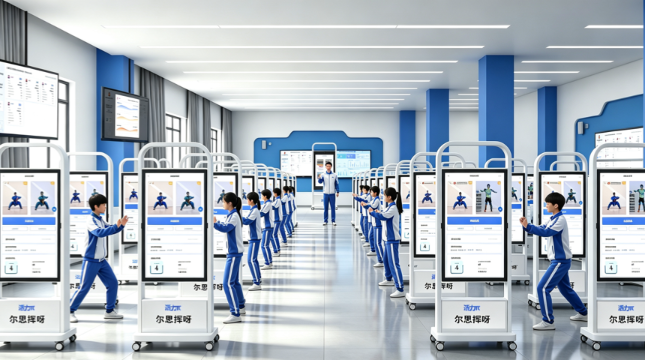
A digital PE system is an integrated hardware and software stack that turns a gymnasium or outdoor field into a sensor-equipped teaching environment. It combines interactive terminals, wearable sensors where appropriate, and a cloud platform that ingests movement data in real time. Instead of a clipboard and a grade book, teachers work with live dashboards; instead of one end-of-term mark, students receive feedback after every lesson.
The Earth Digital Science and Education System developed by Shenzhen Earth Electronics is organized around four cooperating modules: a Teacher Portal, a Student Portal, a Dual Supervision Platform and a Big Data Center. Together they replace the paper-based cycle of plan, teach, test and report with a closed data loop that updates after every class. Teachers who want a broader introduction can read our complete digital physical education guide for schools.
3. Key Components of a Modern PE Assessment Platform
A modern assessment platform is not a single device; it is a stack of four modules that serve different users and reinforce each other. The table below summarises who uses each module and what it delivers.
| Module | Primary User | Core Function | Key Output |
|---|---|---|---|
| Teacher Portal | PE teachers | Lesson planning, real-time class supervision | Live dashboards, corrective cues, class reports |
| Student Portal | Students | Personal feedback and progress tracking | Movement scores, standard comparisons, trend charts |
| Dual Supervision Platform | Teachers and parents | School–home collaboration | Shared activity, attendance and fitness reports |
| Big Data Center | School leaders | Cross-class and cross-school analysis | Fitness analytics, budget and program evidence |
3.1 Teacher Portal: Lesson Planning and Real-Time Supervision
The Teacher Portal is where a PE teacher designs units, retrieves pre-built digital teaching materials and monitors every student on the floor at the same time. Interactive terminals track posture, rhythm and completion counts for calisthenics, jump rope, dumbbell routines and other common activities, then surface each student's performance on a dashboard. Teachers no longer walk the floor with a clipboard: they can mark attention points, push corrective cues to individual screens and export class reports without manual scoring.
3.2 Student Portal: Personalized Feedback and Progress Tracking
Students do not only appear in a teacher's grade book. Through the Student Portal, each pupil can see their own movement score, a side-by-side comparison with a standard demonstration, and a weekly trend chart. That transparency turns assessment into coaching: a child who loses points on squat depth can review the correct movement at home and return with a measurable target. The same data feeds PE entrance exam training plans for older students. Our AI PE entrance exam training guide explains how schools and families can turn that data into daily drills.
3.3 Dual Supervision Platform: School–Home Collaboration
Parents have historically been outsiders in PE. The Dual Supervision Platform closes that gap by giving guardians a controlled view of their child's activity, attendance and fitness trends. When a student misses class, underperforms on endurance or shows unusually rapid improvement, both the teacher and the parent receive the same report. This shared view matters most where PE examinations carry real weight in high-school or college admissions.
3.4 Big Data Center: Evidence-Based Teaching Decisions
At the top of the stack, the Big Data Center aggregates anonymized data across classes, grades and schools. Administrators can see which exercises drive the most improvement, which classes need extra equipment, and whether a curriculum change is actually moving the needle on student fitness. Budget allocation and program evaluation can then be managed with the same evidence-based rigor applied to other academic subjects.
4. How AI and IMU + Vision Fusion Improve Assessment Accuracy
Behind the dashboards is motion technology that has matured rapidly. Cameras capture body posture in real time, while inertial measurement units on equipment or wearables supply high-precision speed, angle and force data. The system compares a student's movement frame by frame against a standard demonstration and highlights the specific differences — the moment a knee bends too early, or the instant force is lost in a throw. For a deeper explanation of the hardware, read our guide to MEMS inertial sensors and sports motion tracking, and our sports motion analysis guide compares AI, inertial and camera approaches side by side.
The combination removes the two biggest flaws of human-scored PE: subjective judgment and delayed feedback. A score is no longer a teacher's impression; it is a comparison against a defined standard, produced in real time and available to the student immediately.
5. How a Digital PE Lesson Runs from Start to Finish
In practice, a digital PE lesson follows a repeatable workflow that makes assessment part of teaching rather than an add-on at the end of the term.
- Before class, the teacher selects or customizes a lesson in the Teacher Portal, choosing exercises, scoring criteria and standard demonstrations.
- During class, students perform in front of interactive terminals or with wearable sensors; the system records each movement, scores it against the standard and pushes live feedback to individual screens.
- Throughout the lesson, the teacher monitors the whole class on a single dashboard and intervenes where the data flags difficulty.
- After class, the platform generates class reports, updates individual progress charts and syncs selected data to parents.
- At the end of each week, administrators review anonymized aggregates in the Big Data Center and adjust the next unit.
The loop repeats with measurable evidence at every step. That continuous feedback — not a single grade — is the real difference from the traditional grade book.
6. Real-World Impact: From Classrooms to Campuses
Schools that adopt a digital PE system typically report three measurable outcomes within a single semester. First, scoring consistency improves, because every student is evaluated against the same algorithmic standard. Second, lesson coverage expands, because teachers can supervise parallel stations at once. Third, student motivation rises, because visible progress turns PE into a challenge with clear goals.
Systems built on this model have been selected for the 2024 and 2025 Liaoning Provincial Recommended Educational Equipment lists and allocated to primary and secondary school physical-education programs in Beijing. According to the company, deployments now cover more than 50 universities and hundreds of K-12 campuses; these are vendor-reported figures and should be verified during formal procurement. Schools planning an adoption can also review our guide to customizable AI physical education equipment to match hardware to their own curriculum.
7. Choosing the Right Digital PE Solution
When evaluating platforms, procurement teams should look beyond marketing slides. Confirm that the vendor owns its sensor and algorithm stack rather than reselling third-party analytics. Verify that the Teacher Portal supports the exercises actually taught in your curriculum — rope skipping and calisthenics are common, but your school may need dumbbells, shuttle runs or track events. Check that data can be exported for district-level reporting, and ask how long it takes to onboard teachers.
Shenzhen Earth Electronics, established in 2000, is a national high-tech enterprise with more than 50 software copyrights and patents and more than 25 years of experience in intelligent sports analysis. Its platforms are designed for full-scenario coverage, from campus teaching to home practice. Start from the campus digital PE solution page to see the architecture, or browse the insights library for more implementation guidance.
8. Frequently Asked Questions
What exactly is a digital PE assessment system?
A digital PE assessment system combines smart terminals, sensor or vision tracking and a cloud platform so teachers can supervise a whole class in real time, score movements against a standard model, generate class reports and store student data in a big-data center instead of a paper grade book.
How accurate is AI-based PE grading compared with a human teacher?
AI systems using IMU + vision fusion score every student against the same algorithmic standard, removing differences between observers. They reconstruct speed, angle and force curves and compare movement frame by frame with a standard demonstration — a level of consistency no single teacher can achieve across forty students.
Does a school need special infrastructure to deploy a teacher portal system?
Most setups run on portable smart terminals and a standard network. Schools typically add terminals to existing gyms rather than rebuilding them, and hardware can be tailored to the curriculum — one reason these systems appear in provincial recommended-equipment catalogues.
Can the student portal really help students prepare for PE entrance exams?
Yes. The same data that grades class performance feeds exam-specific training plans, letting students practise the exact test movements at home and track improvement week by week. Our AI PE entrance exam training guide walks through a complete home-and-school workflow.
How does the dual supervision platform share data with parents?
Parents receive a controlled view of their child's activity, attendance and fitness trends. When a student misses class, underperforms on endurance or improves unusually fast, both teacher and parent see the same report — making school–home collaboration practical rather than theoretical.
How long does it take to see results after adopting digital PE assessment?
Schools typically report more consistent scoring and broader lesson coverage within a single semester. Motivation gains are usually visible even earlier, because students see their own progress charts update after every lesson.
9. Conclusion
Digital PE assessment is not about replacing teachers with screens. It is about giving every teacher the eyes to see forty students at once, every student a mirror that shows the next movement to practise, and every principal the data to fund what actually works. When teacher portals, student dashboards and a central data center are connected by the same motion-recognition engine, PE finally joins the rest of the school as a measured, improvable subject. To see how AI smart sports solutions can be deployed across your campus, explore the full range of platforms and insights at Shenzhen Earth.
Explore Smart Sports Solutions
See how connected motion analysis and data support modern physical education and sports training.
Explore Smart Sports Solutions