
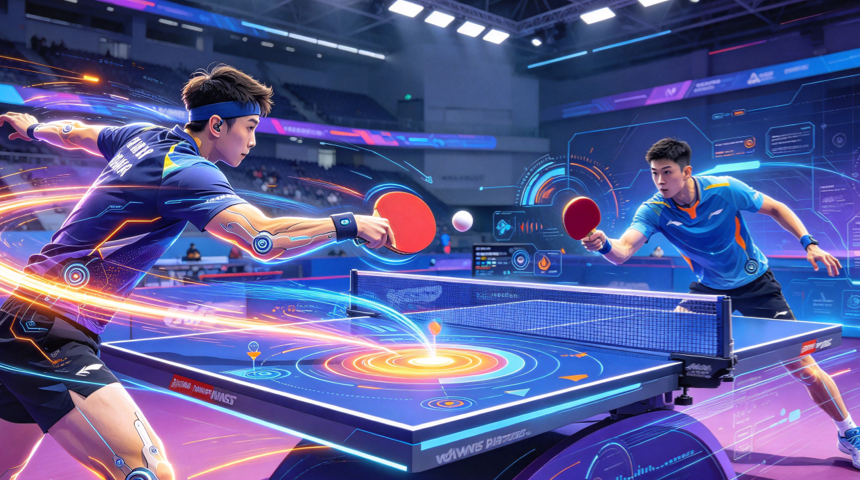
The Limits of Traditional Racket-Sports Coaching
Most table tennis players improve by repetition and intuition. A coach watches a few hundred forehand loops, says the racket is 'too closed,' and sends the player back to the multiball machine. That feedback is necessary, but it is subjective, delayed and impossible to capture across hundreds of rallies. Competitive players and coaches increasingly rely on sensor-based analysis to make feedback objective, measurable and longitudinal.
How Inertial Sensors Capture Racket and Ball Data
Modern racket-sports wearables are built around MEMS inertial measurement units (IMUs) that combine accelerometers and gyroscopes in a tiny chip. Mounted in a racket handle, a paddle edge or a wearable tag, the IMU records every swing thousands of times per second. Via direct Bluetooth connection, the data streams to a phone, tablet or cloud console with no wires and no court-side cameras required. For a deeper technical introduction, our article on MEMS inertial sensors in sports explains how motion tracking actually works.
From Raw Data to Actionable Insights
Swing Speed, Angle and Force Analysis
Raw accelerometer curves are useless to a player. The platform converts them into the language of coaching: swing speed, racket-face angle at contact, impact force, force curve shape and 3D trajectory. A player can see, for example, that their forehand loop averages 18% more acceleration through contact than it did three months ago, or that their backhand drive loses force on the third shot of a multiball sequence. Those details are invisible to even the best coach's eye.
Skill-Level Rating and Progress Tracking
Every session is scored against a benchmark model. The Competitive Sports Platform assigns a skill-level rating that updates as the player trains, so progress is no longer judged by tournament results alone. Coaches can export monthly reports showing which strokes have improved, which have plateaued, and which technical flaw is holding the rating back.
Cloud Analysis and Historical Trends
Because every session is uploaded to the cloud, a player can compare today's forehand against six months of history. Trends surface injuries before they happen (a sudden drop in consistent force may signal shoulder fatigue), reveal which drills actually transfer into matches, and let a traveling player keep working with the same coach remotely. Historical data is what turns a collection of practice sessions into a training plan.
Bluetooth Connectivity and Real-Time Feedback
Wireless design matters. A sensor that requires a cable or a hub on the court will be removed the first time it gets in the way. The newest generation of smart rackets and paddles connects directly over Bluetooth to a phone, so feedback appears within seconds of finishing a drill. Coaches can watch a live feed of their group, highlight the most useful rally on a tablet, and send it to the player's device for review.
Smart Player Matching: Train at the Right Level
Training alone is one thing; playing matches is another. Skill-level ratings also power smart matching, so clubs and academies can pair players of comparable strength for sparring, rather than relying on reputation or tournament seeding. Beginners win more, advanced players are challenged, and court time is used far more efficiently.
Beyond Table Tennis: Badminton, Golf and Tennis
The same IMU + vision fusion architecture extends across racket sports. Badminton strokes, golf club head speed and tennis serve motion all leave characteristic signatures in inertial data. A platform that supports badminton, table tennis, golf and tennis in one ecosystem lets a multi-sport athlete train across seasons on a single dashboard. We have previously explored this approach in depth in our guide to smart badminton training with data analytics.
How Schools and Clubs Use Competitive Sports Platforms
Schools use the same technology in PE class. Students who show aptitude for racket sports are identified by data, not by reputation, and invited into after-school squads. Club coaches can run larger groups with fewer assistants, because the platform handles counting, scoring and technique feedback while the coach focuses on tactics and mental preparation. The same data pipeline also connects home practice: a student who trains at home on the AI smart sports skills platform uploads sessions that the school coach can review before the next team practice.
Building a Data-Driven Training Routine
A practical data-driven routine is simpler than it looks. Start with a baseline session in each major stroke, let the platform establish a skill-level rating, then alternate between structured drills (where the sensor measures form) and match play (where the platform measures real-game behavior). Review the trend chart every two weeks and adjust volume accordingly. Shenzhen Earth Electronics, the company behind the Vitality Pi brand, has been engineering inertial navigation for sports since 2000 and was the world's first private enterprise to launch a smart badminton racket. Learn more on the About Us page or explore the full intelligent sports product range.
Conclusion
Data-driven table tennis training does not replace coaching; it supercharges it. When every swing is recorded, scored and trended, coaching stops being guesswork and starts being engineering. Players know exactly what to fix, coaches know exactly what to prescribe, and clubs know exactly how their members are improving. That is the future of racket-sports development.
Explore Competitive Sports Analytics
See how sensor-equipped sports products and cloud analysis support racket-sports training.
Explore Competitive Sports