
Table of Contents
- 1. The Last Mile of Sports Education Is the Living Room
- 2. Four Home Scenarios for Every Family Member
- 2.1 Skill Learning: A Patient Coach Always Available
- 2.2 Fat-Loss Fitness: Quantifying Real Effort
- 2.3 PE Exam Training: A Home Training Partner
- 2.4 Audio-Visual Entertainment: From Should I Move to I Want to Move
- 3. Why Home-Grade Accuracy Needs Industrial-Grade Sensors
- 4. Building a Movement Ecosystem Across School, Home, Competition
- 4.1 Who Benefits in a Typical Household
1. The Last Mile of Sports Education Is the Living Room
Even when campus PE becomes digitalized, a critical gap remains: students spend only a few hours per week at school, while the rest of the week takes place at home. A serve learned once on Tuesday may be forgotten by Thursday. Parents investing in PE exam scores struggle to provide expert guidance in their living rooms. Office workers want short, safe workouts after hours but risk injury without technical supervision. Older adults need gentle, controlled movement but have no access to instructors at home. These problems share one root cause: professional coaching capacity has historically been concentrated in schools, gyms, and training academies, out of reach for most households.
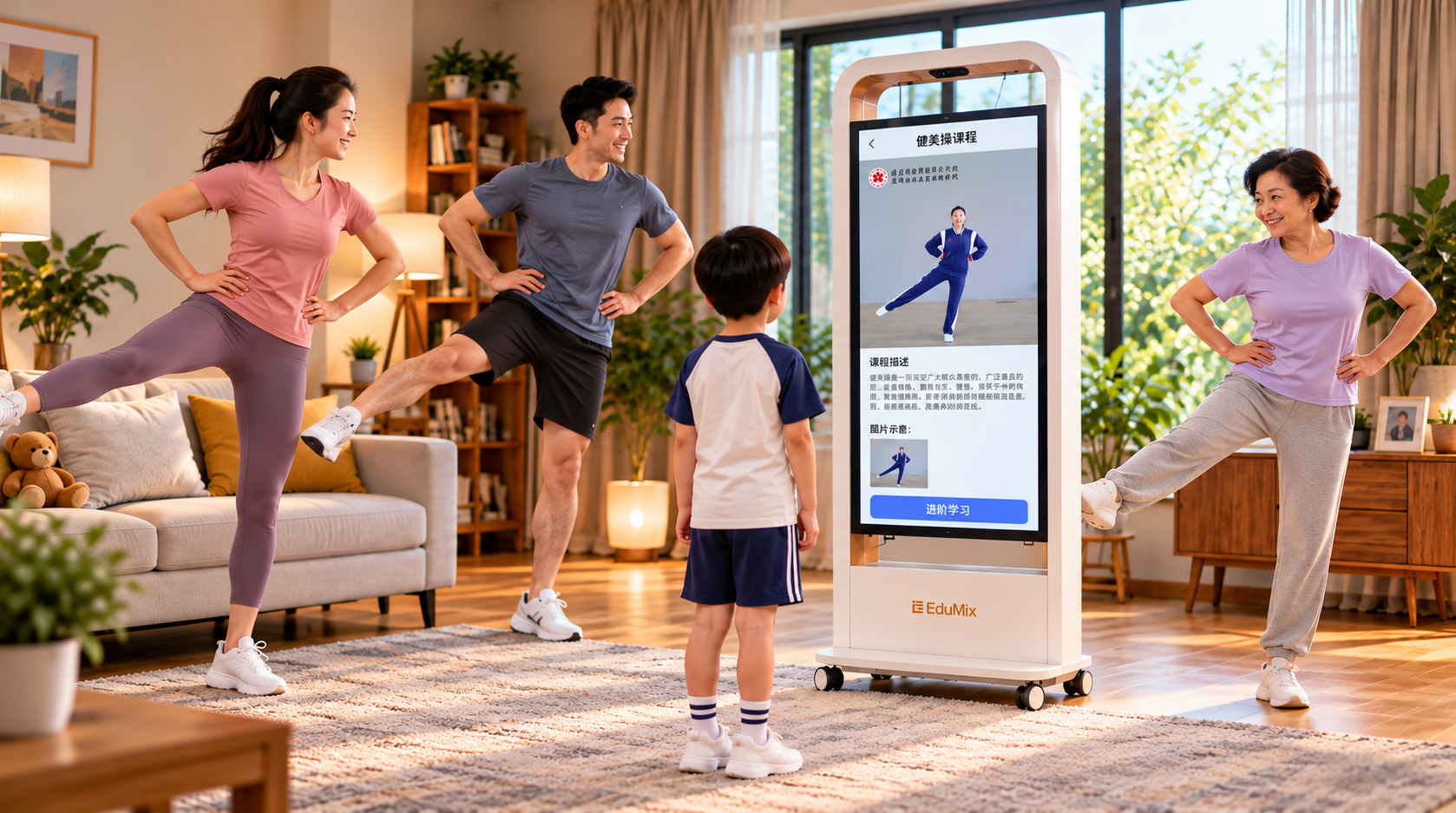
Shenzhen Earth addresses this gap with the AI Smart Sports Skills Platform, a home-facing product that extends the teacher tool into a whole-family health instrument, realizing learn in class and practice at home. It adapts to limited home space and builds a convenient, fun, all-age home exercise ecosystem.

2. Four Home Scenarios for Every Family Member
2.1 Skill Learning: A Patient Coach Always Available
The first scenario is structured skill acquisition. Whether a student wants to learn the correct badminton overhead clear or a child starts table tennis, the system combines intelligent sensor hardware with computer vision to capture movement in real time. It outputs a completion score, a force curve, and a three-dimensional motion trajectory, then explains exactly where the swing path or body angle deviates from the standard. This practice-and-correct loop replicates what a private coach would do, but on demand, at home, and without scheduling constraints.
2.2 Fat-Loss Fitness: Quantifying Real Effort
Generic fitness apps rely on self-reported durations and rough estimates. The ESI platform uses self-developed MEMS inertial sensors to measure actual linear acceleration and angular velocity during exercise, then converts these physical quantities into calibrated workload metrics. Users see true exercise intensity, estimated energy expenditure, and progression over time. Conditioning becomes evidence based rather than guesswork, which is especially valuable for adults managing weight recovery.
2.3 PE Exam Training: A Home Training Partner
As PE carries more weight in entrance examinations, families need structured home preparation. The platform offers exam-specific training modules: students follow system-designed plans, receive real-time technique correction, and track every session score against a target. Parents see measurable progress, students understand the gap to full marks, and training becomes focused rather than generic. This reduces the stress of last-minute cramming and distributes practice across the school year.
2.4 Audio-Visual Entertainment: From Should I Move to I Want to Move
The platform embeds entertainment through guided video workouts, movement challenges, and interactive scoring that turn repetition into play. This gamified design is especially powerful for children: when exercise feels like a game, intrinsic motivation grows, and family movement habits form naturally rather than through parental persuasion.

3. Why Home-Grade Accuracy Needs Industrial-Grade Sensors
A living-room product that looks simple hides non-trivial engineering requirements. A basic webcam detects coarse poses but cannot measure swing speed, racket-face angle, or serve velocity with the precision athletes need. The Vitality Pi brand uses self-developed MEMS strapdown inertial sensors embedded directly into sports equipment, measuring velocity, angle, force, force timing curves, and 3D trajectories without external camera calibration. Crucially, this technology was validated in competitive training and campus teaching before reaching the home, an approach professional-grade technology deployed for everyday use that gives home users confidence in their data.
The campus standard workflow is covered in the digital science and education system, home reinforcement lives here, and competitive refinement continues on the competitive sports platform. Existing guidance on smart badminton training with data analytics pairs naturally with the home skill-learning module. New articles appear in Insights.

4. Building a Movement Ecosystem Across School, Home, Competition
The ESI portfolio spans three tiers: the campus Digital Teaching System, this home AI Smart Sports Skills Platform, and the Competitive Sports Platform for badminton, table tennis, golf, and tennis. Together they form a continuum: children learn skills at school, reinforce them at home, and pursue competition-level refinement through professional data tools. For a family, choosing such a platform is not just about exam scores or quick fat loss; it is an investment in a sustainable, data-informed household lifestyle.
The market backdrop strengthens this case. Households worldwide have invested heavily in home exercise equipment, and demand for guided, interactive, data-rich workouts has outgrown what generic video-on-demand apps can offer. Consumers expect the same feedback at home that they previously received only in a coaching studio. By reusing industrial-grade MEMS sensing already powering elite and campus systems, ESI avoids the compromises of camera-only consumer devices. Parents monitoring exam preparation, office workers tracking recovery, and grandparents following gentle programs all share one accurate measurement layer. When professional coaching becomes as accessible as a living-room screen, the vision of everyone mastering one or two sports starts to feel achievable.
4.1 Who Benefits in a Typical Household
Different family members use the same platform in distinct ways. A secondary-school student opens the exam-training module after dinner, following a plan built around the specific events tested in the local entrance examination; the system records each attempt, corrects posture in real time, and keeps a progress curve that removes guesswork from family conversations about readiness. A working parent uses shorter conditioning sessions before or after work, relying on calibrated workload and energy-expenditure metrics instead of vague feelings of having exercised hard. A younger child uses the entertainment and skill-learning modules, turning basic movement into a playful routine that parents can supervise from the sofa. Grandparents follow low-intensity guided programs that emphasize controlled range of motion and safe pace, with data that helps adult children monitor consistency without overloading them.
This multi-user design matters because a home sports device often fails when it serves only one person. A piece of equipment used solely by the teenager gathers dust once exam season ends; a platform that adapts to every age group instead becomes a recurring household habit. Shared progress views also create gentle social motivation: family members compare weekly activity, celebrate milestones, and turn exercise into a shared evening activity rather than an isolated chore. Combined with small-space adaptation, which avoids requiring a dedicated gym room, the platform lowers the practical barriers that traditionally kept families away from structured home movement.
Cost and maintenance are practical concerns for households as well. Because the platform builds on a compact inertial chip rather than an array of cameras or bulky machines, setup takes minutes, the hardware travels between rooms, and there is no complex calibration after furniture moves. Data syncs to the cloud so that history accumulates across weeks and months, letting users review long-term improvement instead of judging progress from a single good or bad session. This combination of professional measurement, family-wide applicability, and low setup friction defines what a modern home fitness platform should deliver.