
The New Era of Home Fitness
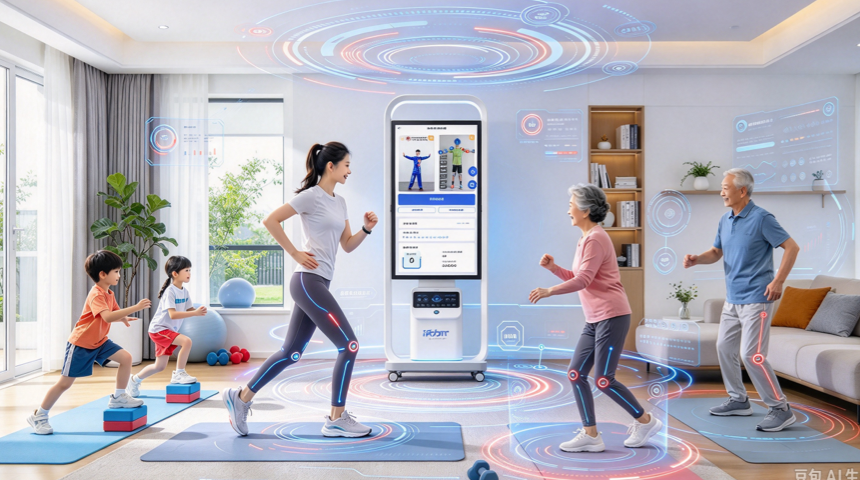
The home gym has evolved from a dusty treadmill in the corner into an interactive, AI-coached training environment. Driven by better cameras, cheaper sensors and cloud computing, the newest generation of AI smart sports platforms is designed for small apartments, busy parents, school-age children and active seniors alike. Instead of following a generic video, the user stands in front of a floor-standing or wall-mounted terminal and receives real-time feedback on every rep, every stretch and every skill drill.
Why AI-Powered Home Sports Matters
Home workouts fail for three predictable reasons: nobody corrects your form, the program bores you after two weeks, and you cannot tell whether you are improving. An AI smart sports skills platform attacks all three at once. It uses the same IMU + vision fusion technology used in elite coaching to compare your movement against a standard, adapt the next session, and record a long-term trend. The result is a fitness experience that feels personal without the cost of a one-to-one trainer.
Core Features of an AI Smart Sports Skills Platform
Sports Learning: From Beginner to Confident Player
Learning a new sport at home no longer requires a court and a coach. The platform breaks skills such as badminton strokes, table tennis footwork, golf swing basics and tennis service motion into short, progressive drills. On-screen demonstrations and voice cues guide each repetition, while the camera checks timing and posture. When the same student later joins a competitive sports platform at school or a club, they already understand the fundamentals.
Fat-Loss Fitness: Data-Backed Workouts
Generic fat-loss programs ignore individual conditioning. A home AI platform adjusts exercise intensity based on the user's heart-rate-derived workload, repetition quality and recovery between sets, and then summarizes calories burned, effective exercise time and movement score on a weekly dashboard. Adults can train 15 to 25 minutes a day in a living room and still see measurable change.
PE Entrance Exam Training: Score Higher at Home
In many education systems, PE scores now count toward middle-school and high-school entrance examinations. Students need repetitive, precise practice in jump rope, sit-ups, squats, running and standing long jump. The home platform counts every repetition, judges form, and mirrors the scoring rubric used in official tests, so weekends and evenings become extra practice sessions rather than lost opportunities. This is the same curriculum that schools use in the digital PE classroom, now continued at home.
Audio-Visual Entertainment: Exercise That Feels Like Play
Sustained fitness needs motivation, and motivation comes from variety. Modern platforms layer games, dance routines and music challenges on top of genuine exercise, so children and seniors alike move because they want to, not because they have to. Leaderboards, unlockable levels and family challenges turn a solo workout into a social activity.
Who Can Benefit? All Age Groups
A single household can use the same equipment for very different goals. A primary-school child works through motor-skill games and PE exam drills; a parent follows a 20-minute fat-loss circuit after work; a grandparent uses low-impact balance and stretching programs. Because the terminal adapts to the user standing in front of it, one purchase serves the whole family. For more on the underlying motion-capture technology, read our explainer on MEMS inertial sensors in sports.
How IMU + Vision Fusion Technology Works
The platform does not guess. A depth-aware camera reads the user's skeleton, while, where relevant, a small inertial navigation chip mounted on a racket, racket grip or wearable accessory records swing speed, acceleration and force curves. The cloud fuses the two data streams and outputs a 3D motion diagram, so the user can literally see how their last swing differed from the model. That closed loop between move, measure and correct is what makes AI coaching credible.
From Living Room to Full Ecosystem: School and Home Continuity
The strongest use case is continuity. A child who trains PE exam drills at home is evaluated by the same standard when they return to the school gym. Homework, classwork and assessment all live on the same platform. Educators can read more about the campus side of this model in How AI is transforming physical education in schools. When school and home speak the same data language, practice outside class finally counts.
Getting Started with AI Home Sports
Choosing a platform should start with three questions. Does it cover the sports and exercises your family actually wants to do? Does the hardware require permanent installation or can it be moved between rooms? And can the device grow with your child from motor-skill games through exam preparation into adult fitness? Shenzhen Earth's AI Smart Home Sports Solution is designed around exactly those requirements: limited-space friendly, age-adaptive and integrated with the campus system. To see the full product portfolio and company background, visit our homepage or the About Us page.
Conclusion
AI home fitness removes the three most common barriers to regular exercise: cost, form feedback and boredom. A single smart sports terminal in the living room can deliver coached skill practice, effective fat-loss training, PE exam preparation and family entertainment, while quietly building the movement habits that last a lifetime. That is what turns a home into a training studio.
Bring Smart Sports Training Home
Explore a connected home fitness platform for sports learning, conditioning, exam preparation and family exercise.
Explore Home Fitness Solutions