
Table of Contents
1. Why Golfers Are Turning to Data
Golf has always been a game of feel. A golfer can hit hundreds of range balls a week and still not say exactly how fast the club was moving, at what angle the clubface arrived, or where the swing lost its power. Coaches have relied on the naked eye and years of experience; players rely on memory. That is changing. AI golf swing analysis puts precise numbers on every swing, so practice is no longer guesswork — it becomes an experiment with recorded results.
The shift matters at every level. Beginners need to know whether they are building a repeatable swing or reinforcing a fault. Intermediates need to see which small change actually moved the ball flight. Professionals need consistency data across hundreds of swings. Sensor technology now delivers all of this without a launch-monitor bay or a wall of cameras.
The cost of feel-based practice is slow, invisible progress. A golfer can spend a month grooving a swing that a sensor would have flagged as inconsistent after the first ten balls. Data shortens that cycle: instead of waiting for ball flight to confirm a change, the numbers confirm it instantly. That is why golfers at every level are adding a sensor to the bag — not to replace coaching, but to make every session, with a coach or without one, more productive.
2. What Is AI Golf Swing Analysis?
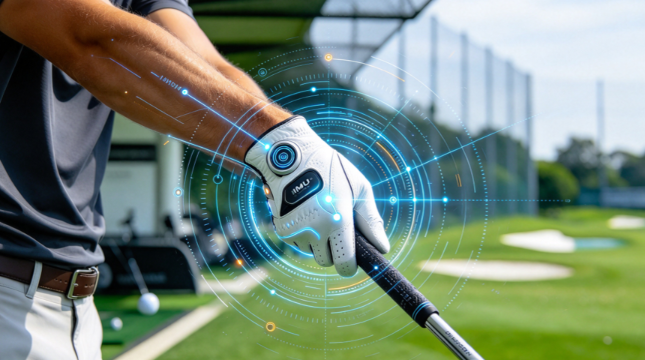
AI golf swing analysis is the combination of a smart sensor, on-device or cloud algorithms, and an app that turns raw motion into coaching feedback. A small inertial chip on the club captures the swing thousands of times per second. Algorithms then reconstruct speed, angle, force, force curves and even 3D motion diagrams, and the system compares the swing against a standard model. The golfer receives not just “that looked good” but the numbers behind it — and the specific part of the swing that needs work.
3. The Technology Behind It: MEMS Inertial Sensors and IMU
At the heart of the system are MEMS inertial sensors — microscopic gyroscopes and accelerometers that measure rotation and acceleration at very high frequency. Using strapdown inertial navigation algorithms, the system fuses these measurements into a continuous trajectory, so it knows where the club was at every instant of the swing. Because the sensor is self-contained, it works indoors, on the range, on the course or at home. For a deeper explanation of the hardware, read our guide to MEMS inertial sensors and sports motion tracking.
Some systems add IMU + vision fusion, layering camera-based pose estimation on top of the sensor data so the analysis also sees body posture and setup. Sensors give precision; vision gives context. Our sports motion analysis guide compares AI, inertial and camera approaches side by side, so you can see which fits your training style.
4. The Key Swing Metrics That Matter
Not every number deserves equal attention. These four metrics give the fastest return on your practice time.
| Metric | What It Measures | Why It Matters |
|---|---|---|
| Swing Speed | Clubhead speed through impact | Distance and consistency |
| Swing Angle & Plane | Club path relative to the target | Shot shape and direction |
| Force & Tempo | Force curve and timing of power | Rhythm and efficient power transfer |
| 3D Motion Diagram | Full reconstructed swing path | Spotting faults quickly |
A coach or an algorithm reads these together. A slow tempo with a late force spike tells a different story from a smooth, early acceleration — and the data shows exactly which one you are producing.
Take tempo as an example. Many amateur swings accelerate too late, creating a late hit that feels powerful but loses efficiency. The force curve shows this clearly: power spikes a few hundredths of a second before impact instead of building smoothly from the top. Once you see that curve, the drill becomes obvious — slow the transition, start the acceleration earlier, and let the sensor confirm the curve changing shape at the next session.
5. How Data Improves Your Practice Routine
Data only helps if it changes what you do on the range. A practical routine looks like this:
- Establish a baseline: hit a set of swings with your normal grip and tempo, and record the key metrics.
- Pick one metric per session: focus on swing speed one week, tempo the next — do not chase five numbers at once.
- Compare with a standard model: use the reference swing in the app to see the exact difference in angle or timing.
- Track trends over weeks: a single session proves little; a line moving upward over a month is real progress.
- Turn data into drills: each drill targets the measured weakness, not a vague feeling.
This is the same “practice with purpose” logic that powers other smart sports. Our guide to smart badminton training and the Vitality Pi smart racket show how racket sports turned swing data into a coaching loop — the same physics applies to golf.
6. From the Driving Range to the Course
The strongest advantage of inertial sensors is portability. The device connects to a smartphone directly over Bluetooth, so data collection happens anywhere there is room to swing. Cloud analysis then produces a skill-level rating, tracks improvement and can even support smart player matching for friendly competition. The same platform that powers golf also covers badminton, table tennis and other racquet sports, because they share the same principle: measure the club or racket, analyse the motion, feed back the correction. See the AI competitive sports platform for the full picture, and our analysis of MEMS and IMU fusion in competitive sports explains how these systems are being used in training centres today.
Skill-level ratings also change how golfers practise and compete. Because every swing produces a number, progress becomes comparable across sessions, coaches and even playing partners. Some platforms use the rating for smart player matching, so friendly games stay close and competitive — the same mechanism already used on the badminton and table tennis side of the platform.
7. Choosing the Right Smart Golf Training System
When choosing a system, look past the marketing. Confirm the sensor is genuine MEMS inertial technology with high sampling rates, not a step counter wearing a golf skin. Check that the app outputs speed, angle, force and trend history — not a single “swing score”. Make sure it works offline and syncs to the cloud, and ask how the feedback loop works: does it tell you what to change, or just what happened? A system that only records is a diary; a system that coaches is a trainer. Explore the insights library at Shenzhen Earth, or start from the homepage to see how one sensor ecosystem spans campus PE, home fitness and competitive sports.
8. Frequently Asked Questions
What is AI golf swing analysis?
It is a smart sensor plus software that captures your swing, reconstructs speed, angle, force and 3D motion, compares the movement with a standard model and gives corrective feedback — turning every practice swing into measurable data.
How accurate are IMU sensors for measuring my swing?
MEMS strapdown inertial navigation chips sample motion at high frequency and reconstruct speed, angle, force, force curves and 3D motion diagrams, which is why they are used in professional sports platforms. When fused with vision, the system can also check posture and setup.
Do I need cameras or a launch monitor to use it?
No. The sensor is self-contained and works anywhere you can swing. Cameras are optional and add posture context when fused with the inertial data.
Can beginners benefit, or is this only for pros?
Beginners often benefit most. The system shows whether a swing is repeatable, which fault to fix first, and whether a change actually worked — feedback a beginner rarely gets from ball flight alone.
How does the sensor attach to a club?
Most designs put a small chip in a smart grip, a bottom cap or a clip-on device on the shaft, connecting to a phone over Bluetooth. Setup takes seconds and does not change the club's feel.
How quickly will I see improvement?
You will see consistent numbers immediately, but meaningful improvement usually shows within a few weeks of focused, one-metric-at-a-time practice — the data lets you verify that each change worked.
9. Conclusion
Golf rewards repetition, but only repetition of the right movement. AI golf swing analysis does not replace a coach or a feel for the game; it makes both better by replacing guesswork with evidence. Whether you are breaking 100 for the first time or squeezing the last yards out of your drive, a sensor, an algorithm and a feedback loop can turn every session into a step forward. To see how smart sports data is built into equipment across golf, badminton, table tennis and campus PE, explore the platforms and insights at Shenzhen Earth.
Explore Smart Sports Solutions
See how connected motion analysis and data support modern physical education and sports training.
Explore Smart Sports Solutions