
Table of Contents
- 1. The Three Persistent Gaps in Traditional School PE
- 2. Four Modules That Close the Teaching Loop
- 2.1 Teacher Portal: From Lesson Plan to Post-Class Report
- 2.2 Student Portal: Learners Become Their Own Coaches
- 2.3 Dual Supervision Platform: Visibility for Schools and Authorities
- 2.4 Central Data Warehouse: Longitudinal Student Health Records
- 3. The Technical Foundation: MEMS Sensing and IMU-Vision Fusion
- 4. Third-Party Validation: Provincial Lists and Municipal Standards
- 5. The Future of Data-Driven Healthy Campuses
- 5.1 Where the System Fits Across the School Day
1. The Three Persistent Gaps in Traditional School PE
For decades, physical education in schools has been held back by three persistent gaps. First, large class sizes make individualized observation nearly impossible: one PE teacher often supervises forty to fifty students at once, and cannot verify whether every student holds a correct posture, trains at a safe intensity, or repeats a flawed movement. Assessment therefore relies on the teacher eye and personal experience rather than objective measurement. Second, the teaching process leaves no durable data trail. A student heart-rate trajectory, technique completion score, and skill mastery curve are not captured after the bell rings, so post-class review lacks evidence and home-school communication stays superficial. Third, campus management and supervision are coarse: administrators and education authorities cannot see in real time whether PE hours are actually delivered, whether students are active enough, or how cohort fitness trends over years.
As healthy-campus policies strengthen and the weight of PE in student evaluation rises, schools need an integrated solution that digitizes instruction, objectifies assessment, and visualizes management. The Earth Digital Science and Education System is Shenzhen Earth answer to this requirement: an AI-powered digital and intelligent healthy-campus solution built on MEMS sensors, IMU-plus-vision fusion, AI, big data, and the internet of things.

2. Four Modules That Close the Teaching Loop
2.1 Teacher Portal: From Lesson Plan to Post-Class Report
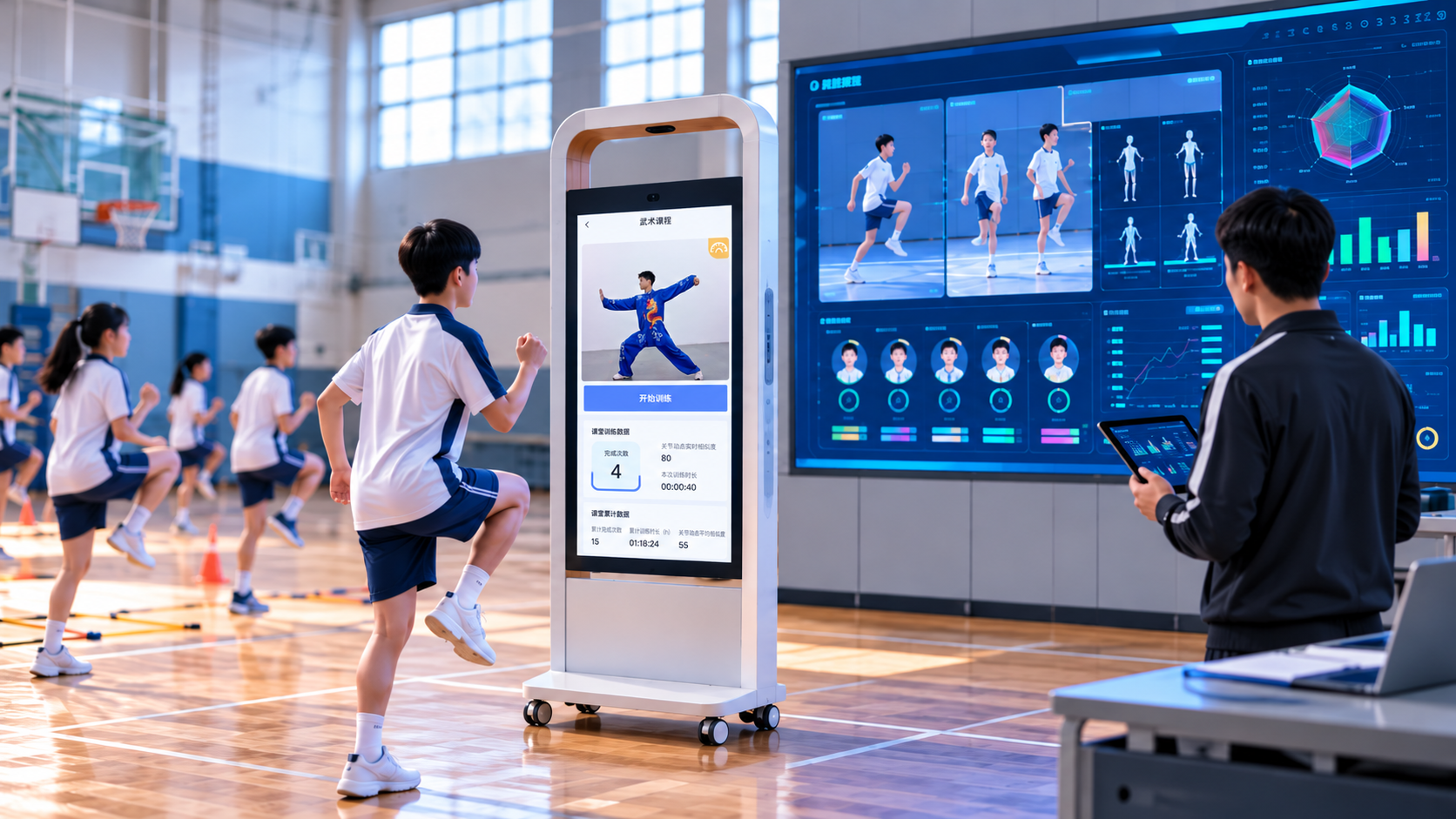
The teacher portal is the instructional core. Before class, teachers retrieve standards-aligned digital PE materials and design lesson plans inside the system. During class, smart sensors collect student movement data and training status in real time, supporting classroom management and precise delivery. After class, the system auto-generates class-level and individual reports, enabling targeted remediation. This closed loop of preparation, acquisition, and analysis frees teachers from manual record keeping and redirects their energy to coaching rather than paperwork.
2.2 Student Portal: Learners Become Their Own Coaches
The student portal pairs intelligent hardware with a friendly application. Students receive immediate feedback on their technique score, progress curve, and the gap between their movement and the standardized model. Instead of guessing what is wrong, they see exactly which joint angle, swing path, or force timing deviates from the benchmark. Immediate feedback is a proven motivator: students become active participants, and the repetition-to-correction cycle shortens dramatically.
2.3 Dual Supervision Platform: Visibility for Schools and Authorities
What distinguishes this system from a teaching app is its dual supervision architecture. School administrators monitor PE scheduling, attendance, workload, and cohort fitness from one dashboard; education authorities obtain an aggregate view across schools in their jurisdiction. Data flows directly from the playground to the management office, replacing paper ledgers and manual spot checks with continuous, auditable records of real-time supervision.
2.4 Central Data Warehouse: Longitudinal Student Health Records
The central data warehouse is the cognitive engine. It accumulates each student PE data from primary through secondary school, building a longitudinal fitness profile. Longitudinal comparisons reveal declining performance or injury risk before they become acute, and cross-sectional benchmarks help teachers calibrate expectations. The system supports improvement in fitness, vision, body weight, and mental wellness, aligning with national healthy-school construction guidance.

3. The Technical Foundation: MEMS Sensing and IMU-Vision Fusion
The platform uses self-developed MEMS strapdown inertial sensors to achieve high-precision data collection and quantitative trajectory analysis, outputting speed, angle, force, force curves, and 3D motion diagrams. On top of this, IMU-plus-vision fusion captures force-generation details in real time, compares movements against a standard model, and displays the precise difference. This stack was not assembled from off-the-shelf consumer parts: Shenzhen Earth is the world first private enterprise to develop a smart badminton racket and the responsible organization for a completed General Administration of Sport of China research project.
4. Third-Party Validation: Provincial Lists and Municipal Standards
A campus product is credible only after real classroom use and formal accreditation. The system was selected into the Liaoning Provincial Recommended Educational Equipment List for both 2024 and 2025, and it has been incorporated into Beijing municipal primary and junior-secondary PE and health teaching equipment allocation standards. An innovation case also won recognition in the Liaoning school educational equipment competition. Today more than fifty universities and numerous K-12 schools use the platform.
For deeper context, read the related insight on how AI is transforming physical education in schools, and browse the full AI-powered digital PE and smart sports solution for application scenarios, function overview, and solution value. Home-based reinforcement connects to the AI smart home sports solution, while advanced skill work moves to the competitive sports analysis platform. More updates are published in the Insights section.

5. The Future of Data-Driven Healthy Campuses
International experience reinforces the same direction. Education systems in Europe, North America, and East Asia increasingly adopt wearables, video-based pose estimation, and learning analytics to make PE more personalized and evidence based. What Shenzhen Earth contributes is a vertically integrated stack: purpose-built sensor hardware, sport-specific algorithms, curriculum-aligned content, and management-grade supervision, all recognized by provincial and municipal authorities. Schools do not need another disconnected gadget; they need a system teachers can operate within a forty-minute class and administrators can trust when reporting upward.
As more campuses pilot these platforms, quality PE will become a baseline expectation rather than a privilege reserved for resource-rich schools. The long-term beneficiaries are the students: a generation that learns with objective feedback, trains on individualized plans, and builds lifelong movement habits on a foundation of data. When AI enters every PE class, healthy campuses stop being a slogan and become a measurable, improvable reality.
5.1 Where the System Fits Across the School Day
The platform is not limited to formal PE lessons. It supports organized PE classes, recess exercise, after-school club activity, and yearly fitness testing as one connected workflow. During structured lessons, teachers use the portal to deliver standards-aligned content and capture technique data. During recess, lightweight terminals encourage casual movement and record participation without disrupting the schedule. During annual fitness tests, the data warehouse turns isolated scores into a comparable longitudinal record that administrators can present to parents and education authorities. Because all stages feed the same central warehouse, a school can answer common leadership questions with one dashboard: how many minutes of moderate-to-vigorous activity did each cohort reach this week, which skills show the weakest mastery across grades, and where are intervention resources best spent. This breadth is what separates a point solution from a campus-wide healthy-school infrastructure, and it is why the system has been accepted into official provincial and municipal equipment standards rather than sold as a niche gadget.
For school decision makers evaluating vendors, three questions matter: whether the hardware survives daily student handling, whether teachers actually adopt the workflow within a normal class period, and whether the exported reports align with the accountability format authorities require. The ESI system was designed around these constraints, with mature deployment in more than fifty universities and many K-12 schools, which reduces the integration risk that a first-time campus pilot usually carries.